
Boundary conditions for the TPBVP
Contents
2.2. Boundary conditions for the TPBVP#
We return to the linear TPBVP,
and now ask what happens when the boundary conditions are not of Dirichlet type. Of particular interest is the Neumann case in which \(G_{11}=G_{21}=0\).
Recall that the discretization of the ODE leads to the initial linear system
In the previous chapter, we used two different approaches to incorporate BCs:
Replace the boundary collocation rows with (discretized) equations for the BCs.
Use the BCs to remove two of the unknowns from the system, as well as the collocated equations on the boundary.
Option 1 is fairly straightforward, though care should be taken to ensure that all the rows of the final matrix have roughly the same scale (as a function of step size). Option 2 is easy for Dirichlet conditions, and it’s more convenient for some theoretical analyses. Here we will look at a third variation, the method of fictitious points or ghost points.
Fictitious points#
Note that we could discretize the ODE all the way to the boundary if we had access to the values \(u_{-1}\) and \(u_{n+1}\), e.g.,
and so on. Of course, the value \(u_{-1}\) is fictitious, based on a node lying outside the domain. But a Neumann BC could be discretized to imply that
Inserting this into the left BC leads to
which can be solved for the fictitious \(u_{-1}\) in terms of \(u_0\) and \(u_1\). Hence, the discretization of the ODE becomes dependent just on those two unknowns, eliminating the explicit presence of the fictitious value.
using LinearAlgebra
p = x -> x+2
q = x -> x^2+1
f = x -> 1
a,b = -1,1
n = 6
h = (b-a)/n
x = [a + i*h for i in 0:n];
We’re going to use rectangular matrices here to reflect the fact that we depend (for now) on \(n+3\) unknowns but have only \(n+1\) collocated ODE equations.
Dxx = 1/h^2 * diagm(n+1,n+3,0=>ones(n+1),1=>-2*ones(n+1),2=>ones(n+1))
7×9 Matrix{Float64}:
 9.0  -18.0    9.0    0.0    0.0    0.0    0.0    0.0  0.0
 0.0    9.0  -18.0    9.0    0.0    0.0    0.0    0.0  0.0
 0.0    0.0    9.0  -18.0    9.0    0.0    0.0    0.0  0.0
 0.0    0.0    0.0    9.0  -18.0    9.0    0.0    0.0  0.0
 0.0    0.0    0.0    0.0    9.0  -18.0    9.0    0.0  0.0
 0.0    0.0    0.0    0.0    0.0    9.0  -18.0    9.0  0.0
 0.0    0.0    0.0    0.0    0.0    0.0    9.0  -18.0  9.0
Dx = 1/2h * diagm(n+1,n+3,0=>-ones(n+1),2=>ones(n+1))
7×9 Matrix{Float64}:
 -1.5   0.0   1.5   0.0   0.0   0.0   0.0  0.0  0.0
  0.0  -1.5   0.0   1.5   0.0   0.0   0.0  0.0  0.0
  0.0   0.0  -1.5   0.0   1.5   0.0   0.0  0.0  0.0
  0.0   0.0   0.0  -1.5   0.0   1.5   0.0  0.0  0.0
  0.0   0.0   0.0   0.0  -1.5   0.0   1.5  0.0  0.0
  0.0   0.0   0.0   0.0   0.0  -1.5   0.0  1.5  0.0
  0.0   0.0   0.0   0.0   0.0   0.0  -1.5  0.0  1.5
A = Dxx + diagm(p.(x))*Dx + diagm(n+1,n+3,2=>q.(x))
v = f.(x)
A
7×9 Matrix{Float64}:
 7.5  -18.0   12.5    0.0       0.0       0.0    0.0       0.0      0.0
 0.0    7.0  -18.0   12.4444    0.0       0.0    0.0       0.0      0.0
 0.0    0.0    6.5  -18.0      12.6111    0.0    0.0       0.0      0.0
 0.0    0.0    0.0    6.0     -18.0      13.0    0.0       0.0      0.0
 0.0    0.0    0.0    0.0       5.5     -18.0   13.6111    0.0      0.0
 0.0    0.0    0.0    0.0       0.0       5.0  -18.0      14.4444   0.0
 0.0    0.0    0.0    0.0       0.0       0.0    4.5     -18.0     15.5
It would be easy to do the algebra that expresses the fictitious values in terms of the regular unknowns. It’s even easier to let the computer do the linear algebra for us, though. So we will add new rows to express the discrete forms of the boundary conditions.
Ga,Gb = [0,1],[1,-1]
⍺,β = 0,0
r₋ = [-Ga[2]/2h Ga[1] Ga[2]/2h zeros(1,n)]
r₊ = [zeros(1,n) -Gb[2]/2h Gb[1] Gb[2]/2h]
A = [r₋;A;r₊]
v = [⍺;v;β]
A
9×9 Matrix{Float64}:
 -1.5    0.0    1.5    0.0       0.0       0.0    0.0       0.0      0.0
  7.5  -18.0   12.5    0.0       0.0       0.0    0.0       0.0      0.0
  0.0    7.0  -18.0   12.4444    0.0       0.0    0.0       0.0      0.0
  0.0    0.0    6.5  -18.0      12.6111    0.0    0.0       0.0      0.0
  0.0    0.0    0.0    6.0     -18.0      13.0    0.0       0.0      0.0
  0.0    0.0    0.0    0.0       5.5     -18.0   13.6111    0.0      0.0
  0.0    0.0    0.0    0.0       0.0       5.0  -18.0      14.4444   0.0
  0.0    0.0    0.0    0.0       0.0       0.0    4.5     -18.0     15.5
  0.0    0.0    0.0    0.0       0.0       0.0    1.5       1.0     -1.5
This is not so different from Option 1 above, except that we get to use centered formulas everywhere. It would be easy to solve the linear system for all the values, including the fictitious ones, but we will go through the linear algebra of removing them, since it’s a recurring practice in computing.
Schur complement#
Suppose the system is partitioned into logical blocks (they need not be contiguous in the matrices):
Here, the groups represent actual/fictitious function values. Note that
and the first block-row of the system becomes
This is easily rearranged into a system \(\tilde{\bfA} \bfu_1 = \tilde{\bfv}\) for the regular unknowns only.
i1,i2 = 2:n+2,[1,n+3]
S = A[i1,i2]/A[i2,i2]
ṽ = v[i1] - S*v[i2]
à = A[i1,i1] - S*A[i2,i1]
Ã
7×7 Matrix{Float64}:
 -18.0   20.0    0.0       0.0       0.0    0.0      0.0
   7.0  -18.0   12.4444    0.0       0.0    0.0      0.0
   0.0    6.5  -18.0      12.6111    0.0    0.0      0.0
   0.0    0.0    6.0     -18.0      13.0    0.0      0.0
   0.0    0.0    0.0       5.5     -18.0   13.6111   0.0
   0.0    0.0    0.0       0.0       5.0  -18.0     14.4444
   0.0    0.0    0.0       0.0       0.0   20.0     -7.66667
u = Ã\ṽ
7-element Vector{Float64}:
 -0.8171782480212244
 -0.6854604232191019
 -0.4514496333585481
 -0.21176569027107778
 -0.007929586517547056
  0.14855354002102633
  0.2570961913591991
n = 200
h = (b-a)/n
x = [a + i*h for i in 0:n]
Dxx = 1/h^2 * diagm(n+1,n+3,0=>ones(n+1),1=>-2*ones(n+1),2=>ones(n+1))
Dx = 1/2h * diagm(n+1,n+3,0=>-ones(n+1),2=>ones(n+1))
A = Dxx + diagm(p.(x))*Dx + diagm(n+1,n+3,2=>q.(x))
v = f.(x)
ra = [-Ga[2]/2h Ga[1] Ga[2]/2h zeros(1,n)]
rb = [zeros(1,n) -Gb[2]/2h Gb[1] Gb[2]/2h]
A = [ra; A; rb]
v = [⍺; v; β]
i1,i2 = 2:n+2,[1,n+3]
S = A[i1,i2]/A[i2,i2]
ṽ = v[i1] - S*v[i2]
à = A[i1,i1] - S*A[i2,i1]
u = Ã\ṽ;

using Plots
plot(x,u,aspect_ratio=1)
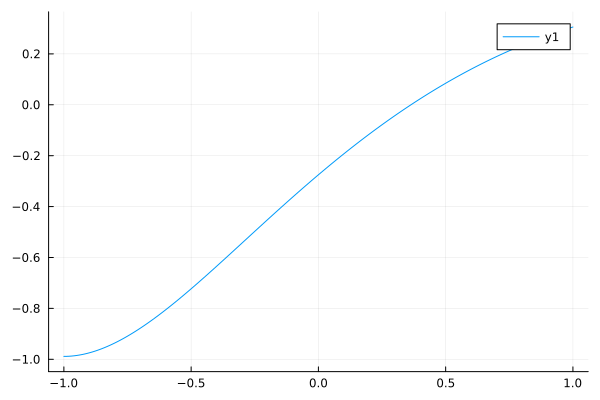
The left end does look like a homogeneous Neumann condition is satisfied. We can check the right end casually using a first-order discretization:
Gb[1]*u[n+1] + Gb[2]*(u[n+1]-u[n])/h - β
-0.002668110755490005