
Indefinite integration
1.1. Indefinite integration#
The simplest possible context for our first finite-difference method is the BVP
The solution of this problem is just an indefinite integral of \(g\). Suppose we discretize the domain \([a,b]\) by choosing the nodes
for a positive integer \(n\). If we want to write a discrete analog of the ODE at each node, then at the first node \(x_0\) we really only have one of the three options above available, the forward difference. Likewise, at \(x_n\) we can only use the backward difference. At the interior nodes, suppose that we use a centered difference. This gives us the discrete equations
It’s much saner to express these using linear algebra:
We will call the matrix in this system a differentiation matrix. It maps a vector of function values to a vector of (approximate) values of its derivative.
using LinearAlgebra
function diffmat1(x)
    # assumes evenly spaced nodes
    h = x[2]-x[1]
    m = length(x)
    Dx = 1/2h*diagm(-1=>[-ones(m-2);-2],0=>[-2;zeros(m-2);2],1=>[2;ones(m-2)])
end

a,b = 0,1
g = x->cos(x)

n = 8
h = (b-a)/n
x = [a + i*h for i in 0:n]
A = diffmat1(x)
9×9 Matrix{Float64}:
 -8.0   8.0   0.0   0.0   0.0   0.0   0.0   0.0  0.0
 -4.0   0.0   4.0   0.0   0.0   0.0   0.0   0.0  0.0
  0.0  -4.0   0.0   4.0   0.0   0.0   0.0   0.0  0.0
  0.0   0.0  -4.0   0.0   4.0   0.0   0.0   0.0  0.0
  0.0   0.0   0.0  -4.0   0.0   4.0   0.0   0.0  0.0
  0.0   0.0   0.0   0.0  -4.0   0.0   4.0   0.0  0.0
  0.0   0.0   0.0   0.0   0.0  -4.0   0.0   4.0  0.0
  0.0   0.0   0.0   0.0   0.0   0.0  -4.0   0.0  4.0
  0.0   0.0   0.0   0.0   0.0   0.0   0.0  -8.0  8.0
b = g.(x)
u = A\b
SingularException(9)

Stacktrace:
 [1] checknonsingular
   @ /Applications/Julia-1.8.app/Contents/Resources/julia/share/julia/stdlib/v1.8/LinearAlgebra/src/factorization.jl:19 [inlined]
 [2] checknonsingular
   @ /Applications/Julia-1.8.app/Contents/Resources/julia/share/julia/stdlib/v1.8/LinearAlgebra/src/factorization.jl:21 [inlined]
 [3] #lu!#170
   @ /Applications/Julia-1.8.app/Contents/Resources/julia/share/julia/stdlib/v1.8/LinearAlgebra/src/lu.jl:82 [inlined]
 [4] #lu#177
   @ /Applications/Julia-1.8.app/Contents/Resources/julia/share/julia/stdlib/v1.8/LinearAlgebra/src/lu.jl:279 [inlined]
 [5] lu (repeats 2 times)
   @ /Applications/Julia-1.8.app/Contents/Resources/julia/share/julia/stdlib/v1.8/LinearAlgebra/src/lu.jl:278 [inlined]
 [6] \(A::Matrix{Float64}, B::Vector{Float64})
   @ LinearAlgebra /Applications/Julia-1.8.app/Contents/Resources/julia/share/julia/stdlib/v1.8/LinearAlgebra/src/generic.jl:1110
 [7] top-level scope
   @ In[2]:2
 [8] eval
   @ ./boot.jl:368 [inlined]
 [9] include_string(mapexpr::typeof(REPL.softscope), mod::Module, code::String, filename::String)
   @ Base ./loading.jl:1428
Wait, what??
Sometimes when the discrete analog of the problem fails spectacularly, it’s actually reflecting an important property of the original problem. Here, we’ve forgotten to impose the boundary/initial condition \(u(a)=0\), and that makes the problem ill-posed. In fact, we know that the integration problem has a 1-dimensional nonuniqueness, and so does the matrix problem here:
U,σ,V = svd(A)
σ
9-element Vector{Float64}:
 12.100392721451549
 12.089289539656962
  7.471591835346571
  7.185353763395404
  5.8641393337995735
  5.245446585976806
  3.2418642763057655
  2.7501012990954647
  5.3315209669936526e-17
The null space even consists of a constant solution:
V[:,end]
9-element Vector{Float64}:
 -0.3333333333333333
 -0.3333333333333333
 -0.3333333333333333
 -0.3333333333333333
 -0.3333333333333332
 -0.3333333333333332
 -0.3333333333333331
 -0.33333333333333304
 -0.33333333333333315
Let’s impose the boundary condition now. In order to keep this a square linear system, we need to replace a row, not add one; the natural choice is the first row.
A[1,1:2] = [1,0];  b[1] = 0;
u = A\b
9-element Vector{Float64}:
 -2.7755575615628914e-17
  0.1315825653503195
  0.24804941680733222
  0.3738106707779807
  0.4806763222854108
  0.5932063112505739
  0.6834171021617153
  0.7761285284690291
  0.8436663167025465
Compare to the exact solution, \(u(x)=\sin(x)\):
[u sin.(x)]
9×2 Matrix{Float64}:
 -2.77556e-17  0.0
  0.131583     0.124675
  0.248049     0.247404
  0.373811     0.366273
  0.480676     0.479426
  0.593206     0.585097
  0.683417     0.681639
  0.776129     0.767544
  0.843666     0.841471
While that’s plausible, it’s not conclusively correct. Let’s do a convergence study.
function fdintegrate(g,a,b,n)
    h = (b-a)/n
    x = [a + i*h for i in 0:n]
    A = diffmat1(x)
    b = g.(x)

    A[1,1:2] = [1,0];  b[1] = 0;

    u = A\b
    return x,u
end

n = [2^k for k in 1:10]
err = []
for n in n
    x,u = fdintegrate(cos,0,1,n)
    û = sin.(x)
    push!(err,norm(u-û)/norm(û))
end

using Plots
plot(n,err,m=4,xaxis=:log10,yaxis=:log10)
order1 = @. (n/n[1])^(-2)
plot!(n,order1,color=:black,l=:dash)
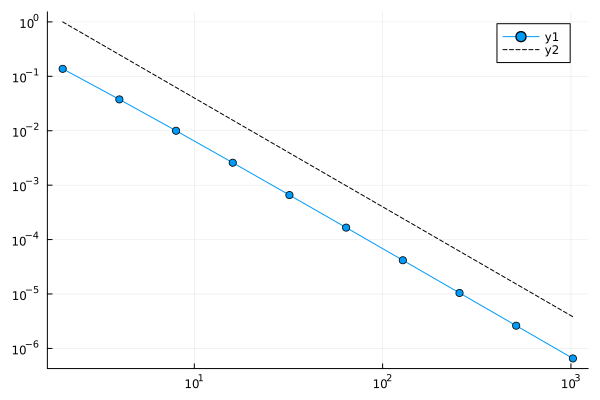
The straight-line convergence on log-log scales means algebraic convergence of the rate \(C n^{-p}\) for a positive order \(p\). The dashed black line shows \(p=2\). How do we explain this convergence order? Stay tuned.