
Roundoff error
Contents
1.3. Roundoff error#
The error formulas derived by series expansions are known as truncation error. In standard methods, these have a leading term that is \(O(h^p)\) for a positive integer \(p\). There is another source of error, however, due to roundoff.
Subtractive cancellation#
Recall that every value and basic operation is represented in the computer up to a relative accuracy of \(\epsm\), known as machine epsilon. In the default double precision,
and we generally say “16 digits of precision” are available. This is usually not an issue—except with certain operations.
Consider the problem \(x - (x-\delta)\). Each operand is represented in the computer by the values
where each \(|\epsilon_i| < \epsm\). Let’s say we are lucky and the subtraction is performed exactly:
We find the relative accuracy of the result is
The first term is as we would hope, but the second will be troublesome if \(|x| \gg |\delta|\). In fact, the relative error can be amplified by their ratio in passing from data to result, and we call this the condition number of the subtraction problem. This is the phenomenon of subtractive cancellation.
using PrettyTables
δ = @. 1/10^(2:13)
x = 3.1416
d = @. x - (x-δ)
err = @. abs(d-δ) / δ
pretty_table([δ d err x*eps()./δ],header=["δ","result","rel. error","bound"])
┌─────────┬─────────────┬─────────────┬─────────────┐
│       δ │      result │  rel. error │       bound │
├─────────┼─────────────┼─────────────┼─────────────┤
│    0.01 │        0.01 │ 2.13371e-14 │ 6.97575e-14 │
│   0.001 │       0.001 │ 1.10155e-13 │ 6.97575e-13 │
│  0.0001 │      0.0001 │ 2.11026e-12 │ 6.97575e-12 │
│  1.0e-5 │      1.0e-5 │ 6.55112e-12 │ 6.97575e-11 │
│  1.0e-6 │      1.0e-6 │ 1.39778e-10 │ 6.97575e-10 │
│  1.0e-7 │      1.0e-7 │  1.63658e-9 │  6.97575e-9 │
│  1.0e-8 │      1.0e-8 │  6.07747e-9 │  6.97575e-8 │
│  1.0e-9 │      1.0e-9 │  8.27404e-8 │  6.97575e-7 │
│ 1.0e-10 │     1.0e-10 │  8.27404e-8 │  6.97575e-6 │
│ 1.0e-11 │     1.0e-11 │  8.27404e-8 │  6.97575e-5 │
│ 1.0e-12 │ 1.00009e-12 │  8.89006e-5 │ 0.000697575 │
│ 1.0e-13 │ 9.99201e-14 │ 0.000799278 │  0.00697575 │
└─────────┴─────────────┴─────────────┴─────────────┘
Optimal accuracy of a FD formula#
Consider the humble forward-difference formula on 2 points,
As \(h\to 0\), the values in the numerator get closer together. Since the numerator is approximately \(hu'(0)\), the condition number of the operation is about \(u(0)/hu'(0)\), which grows without bound as \(h\to 0\). So the computed result for \(u'(0)\) will have errors
The total will be minimized when both contributions in the sum are equal:
and the optimal error is
That is, we can never get better than about 8 digits of accuracy in the result.
In general, the total error for a \(p\)-th order formula is
The optimal error satisfies
As the order increases, we get a larger optimal \(h_*\) (and therefore fewer total nodes over a fixed interval), and the result has a fraction \(p/(1+p)\) of the original accurate digits. For \(p=4\), for example, this implies a tad less than 13 digits.
Here’s a computation of the total errors in 1st- and 2nd-order formulas.
f(x) = sin(2.1x)+cos(x)
exact = 2.1
h = [1/2^n for n in 1:40]
FD1err = []
FD2err = []
for h in h
    FD1 = (f(h)-f(0))/h
    FD2 = (f(h)-f(-h))/2h
    push!(FD1err,abs(FD1-exact))
    push!(FD2err,abs(FD2-exact))
end

using Plots
plot(h,[FD1err FD2err],
    xaxis=:log10,yaxis=:log10,label=["order 1" "order 2"],leg=:topleft)
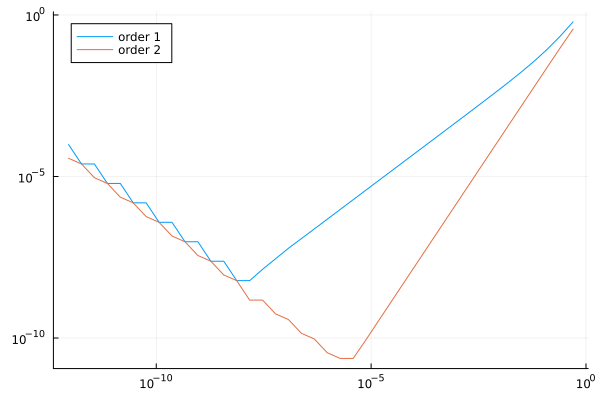
On the right side of the graph above, you see convergence with slopes 1 and 2. But this is eventually dominated by the effect of roundoff, which shows up as a slope of -1.
Instability?#
Should we be looking for a different method to compute derivatives? Consider the abstract problem of mapping a function to its derivative at zero: \( u \mapsto u'(0)\). If we perturb \(u\) by a function \(\delta v(x)\), then the relative error in computing the derivative exactly is
We don’t really have much control over what \(v\) is. Formally, there is no upper bound if we maximize the ratio over all differentiable functions; in functional analysis, differentiation is an unbounded operator.
In numerical practice, \(v\) is a rather noisy function, so we expect the upper bound to be large. Differentiation is an inherently ill-conditioned problem, and there’s no accurate algorithm that can cure that. Fortunately, solving differential equations is not necessarily ill-conditioned, and FD is a valid way to get results almost as accurately as can be expected, provided we use higher-order methods.