
Fourier analysis of finite differences
Contents
1.4. Fourier analysis of finite differences#
Another way to analyze and understand finite differences on regular grids is to apply them to Fourier modes of the form
where \(\xi\) is a wavenumber. For this analysis we ignore boundaries and suppose that there is an infinite set of nodes \(x_k=kh\), \(k\in\mathbb{Z}\).
Observe that
Observation 1.4.1 (Aliasing)
On the grid \(x_k=kh\), \(k\in \mathbb{Z}\), the Fourier mode at wavenumber \(\xi + (2\pi/h)\) is indistinguishable from the mode at wavenumber \(\xi\).
Because of aliasing, all behavior on the grid is periodic in the wavenumber with period \(2\pi/h\), so we restrict attention to
Differentiation factors#
If we look at the simplest centered difference formula, we get
We can call \(g_2\) the differentiation factor. It should be compared to the exact derivative \(u'(0)=i\xi\). Note the series expansion
which is just a restatement of 2nd-order accuracy. However, it is useful to consider the behavior over the full Fourier spectrum. Note that because the differentiation factor depends only on the dimensionless \(\xi h\), it’s enough to use \(h=1\).
using Plots

g₂(ξ) = sin(ξ)
plot(identity,-π,π,color=:black,label="exact",
    aspect_ratio=1,xaxis=([-π,π],"ξh"),yaxis=([-π,π],"diff factor"),leg=:topleft)
plot!(g₂,-π,π,label="order 2")
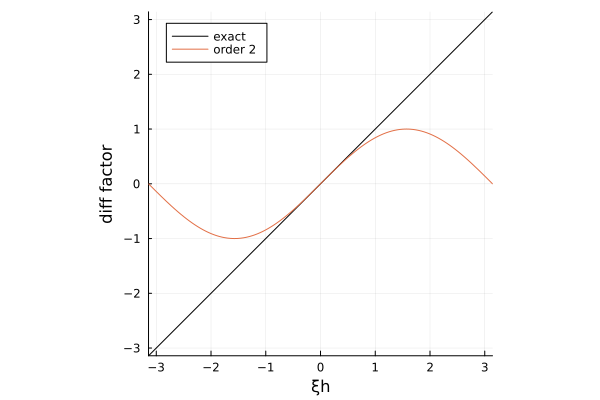
For well-resolved wavenumbers with \(\xi h \ll 1\), the approximation is good, but the mode at \(\xi=\pm \pi/h\) has derivative zero, just like a constant does. This is actually pretty reasonable when you consider that
which is a sawtooth mode on the nodes. No FD method can “see” any underlying behavior between nodes, so the simplest interpretation is that the function has a local extremum at every node.
By going to higher orders of accuracy, we get greater tangency at the origin, but the high-wavenumber behavior doesn’t improve significantly.
using FiniteDifferences,LinearAlgebra

FD4 = FiniteDifferenceMethod(-2:2,1).coefs
g₄(ξ) = imag( dot(FD4,cis.(ξ*(-2:2))) )
plot!(g₄,-π,π,label="order 4")

FD6 = FiniteDifferenceMethod(-3:3,1).coefs
g₆(ξ) = imag( dot(FD6,cis.(ξ*(-3:3))) )
plot!(g₆,-π,π,label="order 6")
ArgumentError: Package FiniteDifferences not found in current path.
- Run `import Pkg; Pkg.add("FiniteDifferences")` to install the FiniteDifferences package.

Stacktrace:
 [1] macro expansion
   @ ./loading.jl:1163 [inlined]
 [2] macro expansion
   @ ./lock.jl:223 [inlined]
 [3] require(into::Module, mod::Symbol)
   @ Base ./loading.jl:1144
 [4] eval
   @ ./boot.jl:368 [inlined]
 [5] include_string(mapexpr::typeof(REPL.softscope), mod::Module, code::String, filename::String)
   @ Base ./loading.jl:1428
Non-centered formulas#
The story gets more complicated with non-centered formulas. The two-point forward formula has, for example,
but here, \(g_1\) is complex-valued.
g₁(ξ) = -1im*(cis(ξ)-1)

plot(identity,-π,π,color=:black,label="exact",
    aspect_ratio=1,xaxis=([-π,π],"ξh"),yaxis=("diff factor"),leg=:topleft)
plot!(real∘g₁,-π,π,label="Re g₁")
plot!(imag∘g₁,-π,π,l=:dash,label="Im g₁")
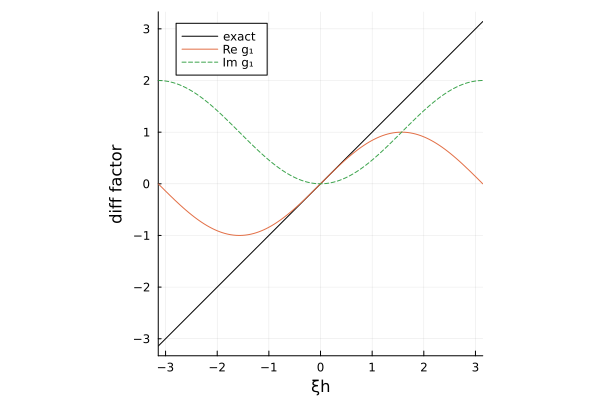
We’ll see later that the nonzero imaginary part here has important implications for PDEs.