
Domain decomposition
Contents
3.5. Domain decomposition#
Rectangles are great and all, but we might like to go beyond them. One attractive technique that generalizes the geometry somewhat is domain decomposition. It can also break a large problem into smaller pieces that are more manageable and perhaps solvable in parallel.
There are two major types of domain decomposition.
Nonoverlapping#
In a nonoverlapping DD method, domain \(\Omega\) is broken into \(\Omega_i\) that intersect only at lower-dimensional interfaces.
For simplicity, consider a domain with two subregions \(\Omega_1\) and \(\Omega_2\), with \(\Gamma_i = \partial \Omega_i \cap \partial \Omega\) and \(\Gamma_{12} = \partial \Omega_1 \cap \partial \Omega_2\). You can imagine that both \(\Omega_i\) are rectangles in practice, but this is not important in principle. It can be shown that the solution of
where \(B\) is a linear operator of differential order 0 or 1, is equivalent to the solution of the subproblems
coupled by the interface conditions
When we discretize the subregions, we can group the nodes of each into ordinary and interface nodes. In a conforming method, the interface nodes of the subregions are collocated on \(\Gamma_{12}\), which allows us to impose the coupling conditions at them. (Otherwise we must take an approach that interpolates between the sets of interface nodes or imposes the coupling in an integral sense.)
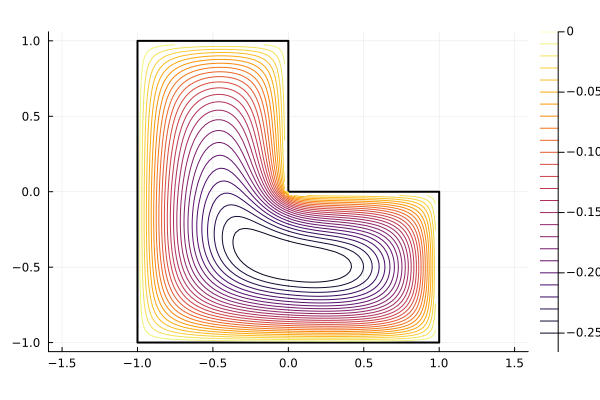
Let’s solve a Poisson equation on an L-shaped domain. We start by defining indicator functions to flag points on the true boundary and on the interface.
using LinearAlgebra
⊗ = kron
include("diffmats.jl")

function isboundary(xy)
    x,y = xy
    return (x==-1) | (x==1) | (y==-1) | (y==1) |
        ((x==0) & (y>=0)) | ((y==0) & (x>=0))
end

function isinterface(xy)
    return ((xy[1]==0) & (-1<xy[2]<0))
end
isinterface (generic function with 1 method)
Now we define structures that describe two rectangular subregions. Each has its own discretization, index vectors for boundary and interface points, and an operator for the normal derivative.
function domains(n)
    R₁ = (nx=n,xspan=(-1,0),ny=2n,yspan=(-1,1),normal=1.)
    R₂ = (nx=n,xspan=(0,1),ny=n,yspan=(-1,0),normal=-1.)

    region = []
    for R in (R₁,R₂)
        nx,ny = R.nx,R.ny
        x,Dx,Dxx = diffmats(R.nx,R.xspan...)
        y,Dy,Dyy = diffmats(R.ny,R.yspan...)
        N = (nx+1)*(ny+1)
        Δ = I(ny+1)⊗Dxx + Dyy⊗I(nx+1)
        grid = vec([[x,y] for x in x, y in y])
        onbdy = isboundary.(grid)
        oniface = isinterface.(grid)
        interior = @. !onbdy & !oniface
        Dnorm = R.normal*(I(ny+1)⊗Dx)[oniface,:]

        push!(region,(;x,y,nx,ny,N,Δ,grid,onbdy,oniface,interior,Dnorm))
    end

    offset = [0,region[1].N]
    idx = []
    for (k,r) in zip(offset,region)
        all = k.+(1:r.N)
        iface = k.+findall(r.oniface)
        bdy = k.+findall(r.onbdy)
        push!(idx,(;all,iface,bdy))
    end

    return region,idx
end;
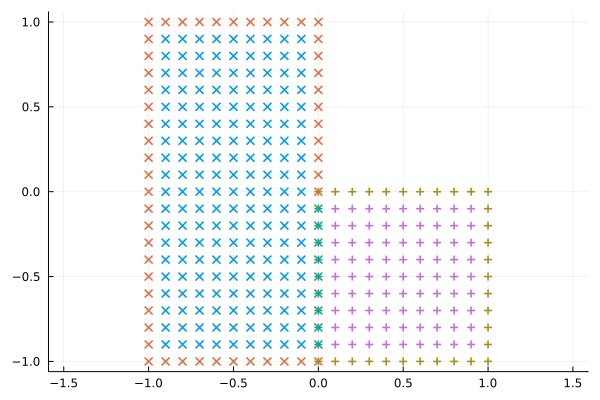
Here we can see a coarse discretization. Notice that the unknowns on the interface coincide for the two subregions.
using Plots
region,idx = domains(10)
fig = plot(aspect_ratio=1,m=3,leg=false)
for (i,r,sym) in zip(idx,region,[:x,:+])
    for s in [r.interior,r.onbdy,r.oniface]
        x,y = [p[1] for p in r.grid[s]],[p[2] for p in r.grid[s]]
        scatter!(x,y,m=sym,msw=2)
    end
end
fig
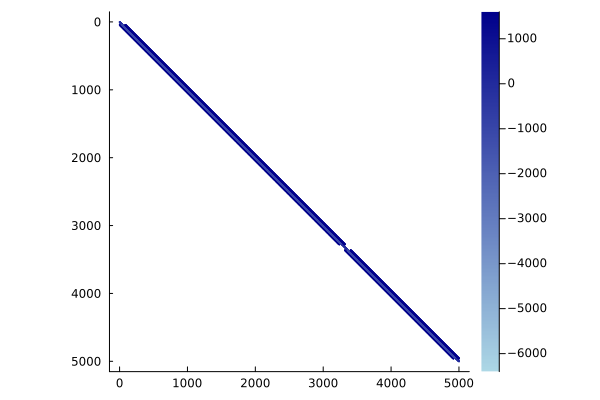
The system matrix \(A\) begins by discretizing each subdomain independently, including the true boundary conditions. The result is a block-diagonal matrix.
f(x) = x[1]+2  # forcing function
region,idx = domains(40)

N = sum(r.N for r in region)
A = sparse(zeros(N,N))
b = zeros(N)
for (i,r) in zip(idx,region)
    A[i.all,i.all] = r.Δ
    b[i.all] = f.(r.grid)
    A[i.bdy,:] .= I(N)[i.bdy,:]
    b[i.bdy] .= 0
end
spy(A,color=:blues)
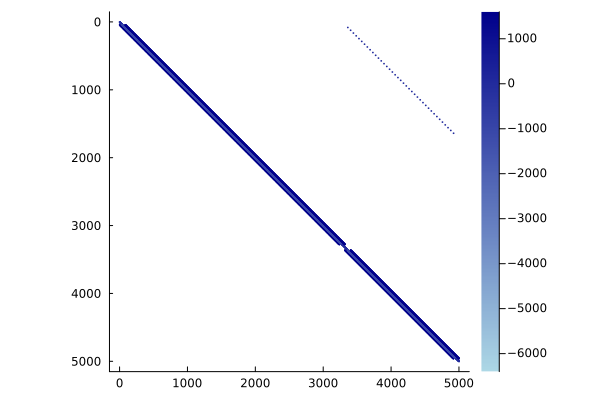
Next, we impose the continuity of \(u\) along the interface.
Ni = length(idx[1].iface)
A[idx[1].iface,:] .= 0
A[idx[1].iface,idx[1].iface] = spdiagm(ones(Ni))
A[idx[1].iface,idx[2].iface] = -spdiagm(ones(Ni))
b[idx[1].iface] .= 0
spy(A,color=:blues)
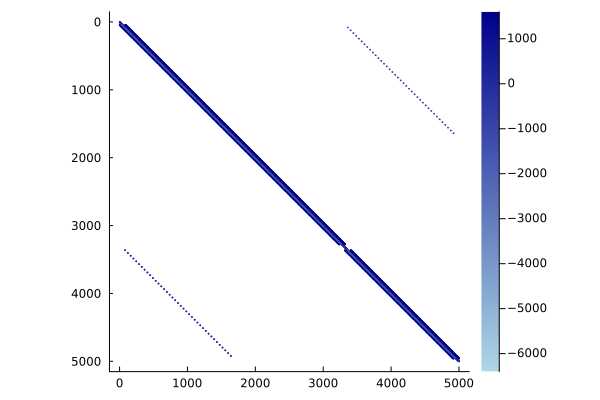
Finally, we impose the continuity of the normal derivative. (We could instead use the Schur complement technique to simply remove the interface unknowns from the linear system.)
A[idx[2].iface,:] .= 0
A[idx[2].iface,idx[1].all] = region[1].Dnorm
A[idx[2].iface,idx[2].all] = region[2].Dnorm
b[idx[2].iface] .= 0
spy(A,color=:blues)
Now it’s all over except the crying.
u = A\b;
plt = plot([-1,-1,1,1,0,0,-1],[1,-1,-1,0,0,1,1],l=(2,:black),label="",aspect_ratio=1)
for (i,r) in zip(idx,region)
    contour!(r.x,r.y,u[i.all],levels=-.25:0.01:0)
end
plt
Overlapping#
A more versatile technique is to use overlapping subdomains. The two subdomains \(\Omega_1\) and \(\Omega_2\) still have the true boundaries \(\Gamma_i = \partial \Omega_i \cap \partial \Omega\), but now we let
This decomposes \(\partial \Omega_i\) as \(\Gamma_i \cup \tilde{\Gamma}_i\) in nonintersecting fashion. Now the solution of the global problem
is equivalent to the solution of the subproblems
where \(P_i\) represents the projection, say by interpolation, of a function defined in \(\Omega_{3-i}\) into one defined on \(\tilde{\Gamma}_i\). That is, a subsolution on one subdomain must agree with the other subsolution on the part of its boundary that lies inside the other subdomain. Note that no normal derivative (Neumann condition) is required. This formulation is straightforward to generalize to more than two overlapping subdomains.
The classical Schwarz alternating method (technically, multiplicative Schwarz) is to seek a fixed point of the new formulation solving alternately on the subdomains, each time pulling its boundary information from the most recent solution(s) on the other subdomain(s). Often we might prefer the additive form, in which the subdomain problems are all solved simultaneously with the “previous generation” of subsolutions. This gives an algorithm of the form parallel solve, communicate via interfaces, parallel solve, etc.
While the Schwarz methods make it easy to parallelize the solution process and give some global geometric flexibility, the overlap regions are doubly discretized, which is in some sense wasteful. Furthermore, the convergence rate of the process degrades as the amount of overlap decreases, and when a large number of subdomains is used, there needs to be a coarse global discretization in order to speed up communication between distant parts of the domain. The method is frequently used as a preconditioner in an iterative solution of the global problem.
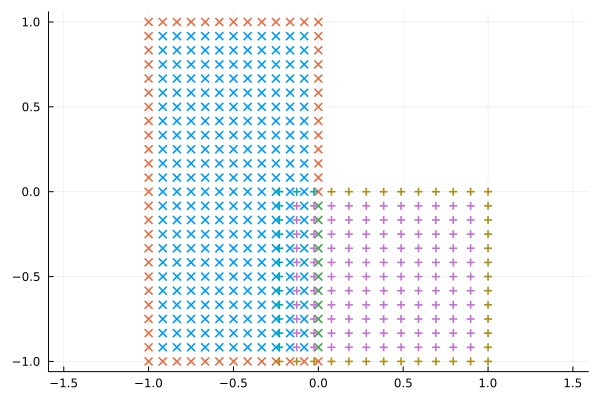
The subregions in our Poisson problem are set up a bit differently here. Note that the “interface” points, or those on the penetrating part of the boundary, are not aligned with nodes in the other subregion.
⊗ = kron
include("diffmats.jl")

function isboundary(xy)
    x,y = xy
    return (x==-1) | (x==1) | (y==-1) | (y==1) |
        ((x==0) & (y>=0)) | ((y==0) & (x>=0))
end

function isinside(xy,xspan,yspan)
    x,y = xy
    return (xspan[1] < x < xspan[2]) && (yspan[1] < y < yspan[2])
end

function isinterface(xy)
    return ((xy[1]==0) & (-1<xy[2]<0))
end

function domains(n)
    R = [
    (nx=n,xspan=(-1,0),ny=2n,yspan=(-1,1)),
    (nx=n,xspan=(-0.23,1),ny=n,yspan=(-1,0))
    ]

    region = []
    for i in 1:2
        nx,ny = R[i].nx,R[i].ny
        x,Dx,Dxx = diffmats(R[i].nx,R[i].xspan...)
        y,Dy,Dyy = diffmats(R[i].ny,R[i].yspan...)
        N = (nx+1)*(ny+1)
        Δ = I(ny+1)⊗Dxx + Dyy⊗I(nx+1)
        grid = [[x,y] for x in x, y in y]
        interior = falses(nx+1,ny+1)
        interior[2:nx,2:ny] .= true
        oniface = .!interior
        otherR = R[3-i]
        for idx in findall(oniface)
            if !isinside(grid[idx],otherR.xspan,otherR.yspan)
                oniface[idx] = false
            end
        end
        onbdy = isboundary.(grid)
        push!(region,(;x,y,nx,ny,N,Δ,grid,onbdy,oniface,interior))
    end
    return region
end
domains (generic function with 1 method)
using Plots
region = domains(12)
fig = plot(aspect_ratio=1,m=3,leg=false)
for (r,sym) in zip(region,[:x,:+])
    for s in [r.interior,r.onbdy,r.oniface]
        x,y = [p[1] for p in r.grid[s]],[p[2] for p in r.grid[s]]
        scatter!(x,y,m=sym,msw=2)
    end
end
fig
The following function performs one Schwarz iteration. It updates each region in turn and thus qualifies as a multiplicative method; if they were updated in parallel, it would be an additive method.
using BlockArrays,Dierckx

function schwarz(u,f,region)
    for (i,R) in enumerate(region)
        A = R.Δ
        b = f.(vec(R.grid))

        # True boundary conditions (Dirichlet)
        onbdy = vec(R.onbdy)
        for idx in findall(onbdy)
            b[idx] = 0
            A[idx,:] .= 0
            A[idx,idx] = 1
        end

        # Interface conditions
        other = 3-i
        uu = reshape(u[Block(other)],region[other].nx+1,region[other].ny+1)
        s = Spline2D(region[other].x,region[other].y,uu,kx=1,ky=1)
        oniface = vec(R.oniface)
        for idx in findall(oniface)
            b[idx] = s(R.grid[idx]...)
            A[idx,:] .= 0
            A[idx,idx] = 1
        end

        u[Block(i)] .= A\b
    end
    return u
end
schwarz (generic function with 1 method)
region = domains(40)
f(x) = x[1]+2  # forcing function
N = [r.N for r in region]
u = BlockVector(zeros(sum(N)),N)

anim = @animate for i in 1:10
    global u
    plt = plot([-1,-1,1,1,0,0,-1],[1,-1,-1,0,0,1,1],l=(2,:black),label="",
        aspect_ratio=1,dpi=100)
    for (i,R) in enumerate(region)
        U = reshape(u[Block(i)],R.nx+1,R.ny+1)
        contour!(R.x,R.y,U',levels=-.25:0.01:0)
    end
    u = schwarz(u,f,region)
    plt
end

mp4(anim,"schwarz.mp4",fps=1)
┌ Info: Saved animation to
│   fn = /Users/driscoll/Dropbox/class/817/notes/elliptic/schwarz.mp4
└ @ Plots /Users/driscoll/.julia/packages/Plots/4UTBj/src/animation.jl:154