
Tensor-product grids
Contents
3.1. Tensor-product grids#
We will consider Poisson on a rectangle \(\Omega = [a,b]\times [c,d]\). If \(x_0,\dots,x_m\) is a sequence of nodes in \([a,b]\), and \(y_0,\dots,y_n\) is a sequence of nodes in \([c,d]\), then a natural grid on the rectangle is the tensor-product grid
This makes it natural to represent a function \(u(x,y)\) as the matrix \(\bfU\), where
Caution
There is potential for confusion because the first dimension of a matrix varies in the vertical direction, while the first coordinate \(x\) varies horizontally. In fact, the Julia plotting routines we use expect the transpose of this arrangement, so that \(x\) varies along columns and \(y\) along rows.
Example 3.1.1
Let the interval \([0,2]\) be divided into \(m=4\) equally sized pieces, and let \([1,3]\) be discretized in \(n=2\) equal pieces. Then the grid in the rectangle \([0,2]\times[1,3]\) is given by all points \((i/2,1+j)\) for all choices \(i=0,1,2,3,4\) and \(j=0,1,2\). If \(f(x,y)=\sin(\pi xy)\), then
Here is the grid from this example.
m = 4;   x = range(0,2,m+1);
n = 2;   y = range(1,3,n+1);
For a given \(f(x,y)\) we can find \(\operatorname{mtx}(f)\) by using a comprehension syntax.
f = (x,y) -> cos(π*x*y-y)
F = [ f(x,y) for x in x, y in y ]
5×3 Matrix{Float64}:
  0.540302  -0.416147  -0.989992
  0.841471   0.416147  -0.14112
 -0.540302  -0.416147   0.989992
 -0.841471   0.416147   0.14112
  0.540302  -0.416147  -0.989992
using Plots
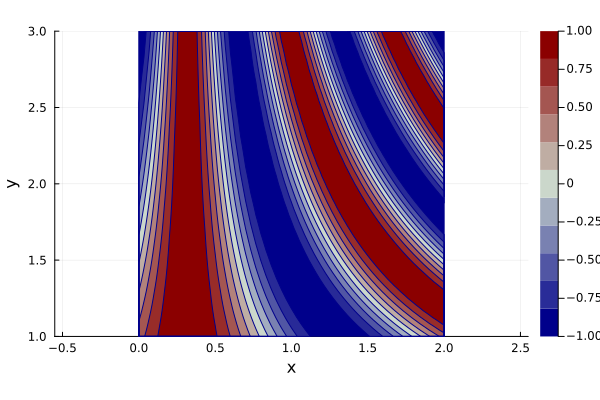
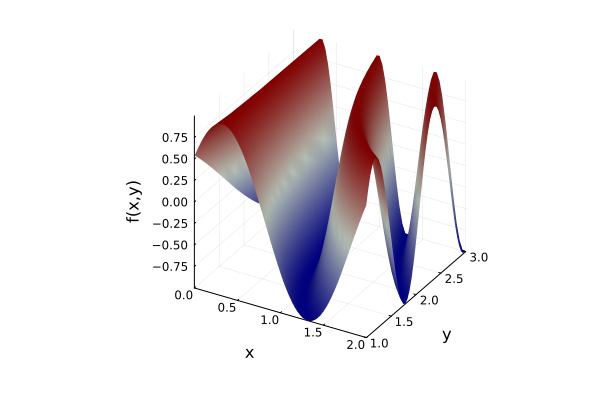
We can make a nice plot of the function by first choosing a much finer grid. However, the contour and surface plotting functions expect the transpose of mtx(\(f\)).
To emphasize departures from a zero level, use a colormap such as bluesreds, and use clims to set balanced color differences.
m = 60;   x = range(0,2,m+1);
n = 48;   y = range(1,3,n+1);
F = [ f(x,y) for x in x, y in y ];

plot(x,y,F',levels=10,fill=true,aspect_ratio=1,
    color=:bluesreds,clims=(-1,1),
    xlabel="x",ylabel="y")
surface(x,y,F',l=0,leg=:none,
    color=:bluesreds,clims=(-1,1),
    xlabel="x",ylabel="y",zlabel="f(x,y)")
Parameterized surfaces#
We are not limited to rectangles by tensor products. Many regions and surfaces may be parameterized by means of \(x(u,v)\), \(y(u,v)\), and \(z(u,v)\), where \(u\) and \(v\) lie in a rectangle. Such “logically rectangular” surfaces include the unit disk,
and the unit sphere,
For a function given in polar form, such as \(f(r,\theta)=1-r^4\), construction of a function over the unit disk is straightforward using a grid in \((r,\theta)\) space.
r = range(0,1,length=41)
θ = range(0,2π,length=81)
F = [ 1-r^4 for r in r, θ in θ ]

surface(r,θ,F',legend=:none,l=0,color=:viridis,
    xlabel="r",ylabel="θ",title="A polar function")
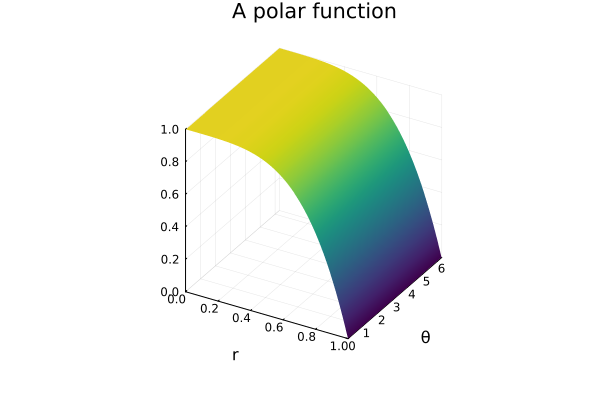
Of course, we are used to seeing such plots over the \((x,y)\) plane, not the \((r,\theta)\) plane. For this we create matrices for the coordinate functions \(x\) and \(y\).
X = [ r*cos(θ) for r in r, θ in θ ]
Y = [ r*sin(θ) for r in r, θ in θ ]

surface(X',Y',F',legend=:none,l=0,color=:viridis,
    xlabel="x",ylabel="y",title="Function on the unit disk")
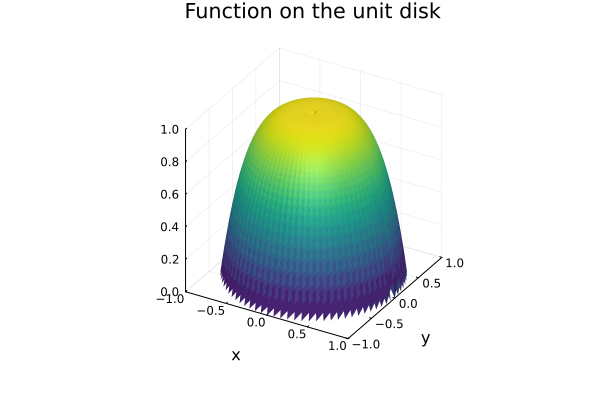
In such functions the values along the line \(r=0\) must be identical, and the values on the line \(\theta=0\) should be identical to those on \(\theta=2\pi\). Otherwise the interpretation of the domain as the unit disk is nonsensical. If the function is defined in terms of \(x\) and \(y\), then those can be defined in terms of \(r\) and \(\theta\) using (3.1.1).
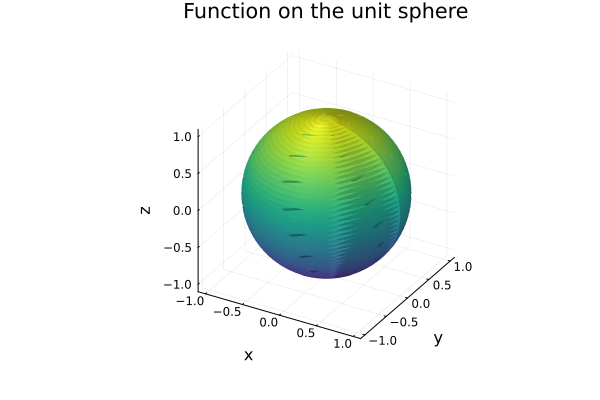
On the unit sphere, we can use color to indicate a function value. Here is a plot of the function \(f(x,y,z) = x y z^3\). Since we need coordinate function matrices for the plot, we also use them to evaluate \(f\) on the grid.
θ = range(0,2π,length=61)
ϕ = range(0,π,length=51)

X = [ cos(θ)*sin(ϕ) for θ in θ, ϕ in ϕ ]
Y = [ sin(θ)*sin(ϕ) for θ in θ, ϕ in ϕ ]
Z = [ cos(ϕ) for θ in θ, ϕ in ϕ ]

F =  @. X*Y*Z^3
surface(X',Y',Z',fill_z=F',l=0,leg=:none,color=:viridis,
    xlims=(-1.1,1.1),ylims=(-1.1,1.1),zlims=(-1.1,1.1),
    xlabel="x",ylabel="y",zlabel="z",
    title="Function on the unit sphere")
Partial derivatives#
In order to solve boundary-value problems in one dimension by collocation, we replaced an unknown function \(u(x)\) by a vector of its values at selected nodes and discretized the derivatives in the equation using differentiation matrices. We use the same ideas in the 2D case: we represent a function by its values on a grid, and multiplication by differentiation matrices to construct discrete analogs of the partial derivatives \(\frac{\partial u}{\partial x}\) and \(\frac{\partial u}{\partial y}\).
Consider first \(\frac{\partial u}{\partial x}\). In the definition of this partial derivative, the independent variable \(y\) is held constant. Note that \(y\) is constant within each column of \(\mathbf{U} = \mtx(u)\). Thus, we may regard a single column \(\mathbf{u}_j\) as a discretized function of \(x\) and, as usual, left-multiply by a differentiation matrix \(\mathbf{D}_x\). We need to do this for each column of \(\mathbf{U}\) by \(\mathbf{D}_x\), which is accomplished by \(\mathbf{D}_x \mathbf{U}\). Altogether,
This relation is not an equality, because the left-hand side is a discretization of the exact partial derivative, while the right-hand side is a finite-difference approximation. Yet it is a natural analog for partial differentiation when we are given not \(u(x,y)\) but only the grid value matrix \(\mathbf{U}\).
Now we tackle \(\frac{\partial u}{\partial y}\). Here the inactive coordinate \(x\) is held fixed within each row of \(\mathbf{U}\). However, if we transpose \(\mathbf{U}\), then the roles of rows and columns are swapped, and now \(y\) varies independently down each column. This is analogous to the situation for the \(x\)-derivative, so we left-multiply by a finite-difference matrix \(\mathbf{D}_y\), and then transpose the entire result to restore the roles of \(x\) and \(y\) in the grid. Fortunately, linear algebra allows us to express the sequence transpose–left-multiply–transpose more compactly:
Keep in mind that the differentiation matrix \(\mathbf{D}_x\) is based on the discretization \(x_0,\ldots,x_m\), and as such it must be \((m+1)\times (m+1)\). On the other hand, \(\mathbf{D}_y\) is based on \(y_0,\ldots,y_n\) and is \((n+1)\times (n+1)\). This is exactly what is needed dimensionally to make the products consistent.
We define a function and, for reference, its two exact partial derivatives.
u = (x,y) -> sin(π*x*y-y);
∂u_∂x = (x,y) -> π*y*cos(πx*y-y);
∂u_∂y = (x,y) -> (π*x-1)*cos(π*x*y-y);
foreach(println,readlines("diffmats.jl"))
using LinearAlgebra,SparseArrays
function diffmats(m,a,b)
    # assumes evenly spaced nodes
    h = (b-a)/m
    x = [ a+i*h for i in 0:m ]
    Dx = 1/2h*spdiagm(-1=>[-ones(m-1);-2],0=>[-2;zeros(m-1);2],1=>[2;ones(m-1)])
    Dxx = 1/h^2*spdiagm(-1=>[ones(m-1);-2],0=>[1;-2*ones(m-1);1],1=>[-2;ones(m-1)])
    Dxx[m+1,m-1] = Dxx[1,3] = 1/h^2
    return x,Dx,Dxx
end
We use an equispaced grid and second-order finite differences.
include("diffmats.jl")
x,Dx,_ = diffmats(m,0,2)
y,Dy,_ = diffmats(n,1,3)
mtx = (f,x,y) -> [ f(x,y) for x in x, y in y ]
U = mtx(u,x,y)
∂xU = Dx*U;
∂yU = U*Dy';
Now we compare the exact \(\frac{\partial u}{\partial y}\) with its finite-difference approximation.
M = maximum(abs,∂yU)    # find the range of the result
plot(layout=(1,2),aspect_ratio=1,clims=(-M,M),xlabel="x",ylabel="y")
contour!(x,y,mtx(∂u_∂y,x,y)',layout=(1,2),levels=12,
    fill=true,color=:bluesreds,title="∂u/∂y")
contour!(x,y,∂yU',subplot=2,levels=12,
    fill=true,color=:bluesreds,title="approximation")
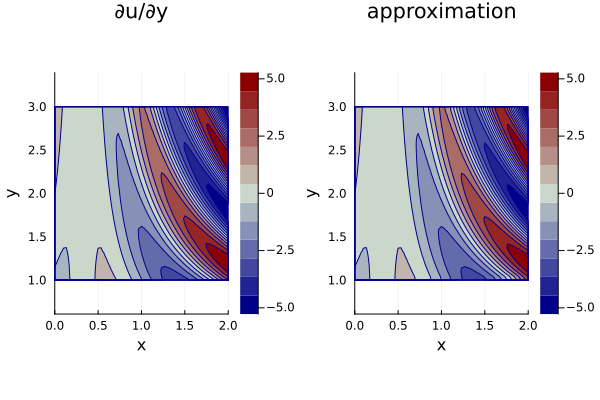
To the eye there is little difference to be seen, though the results have no more than a few correct digits at these discretization sizes:
exact = mtx(∂u_∂y,x,y)
# Relative difference in Frobenius norm:
norm(exact-∂yU) / norm(exact)
0.01961274665432435