
Multistep and RK methods
Contents
4.1. Multistep and RK methods#
The archetype of all IVP solvers is Euler’s method, which for fixed step size \(\tau\) is defined by
function euler(ivp,n)
    a,b = ivp.tspan
    τ = (b-a)/n
    t = [a+i*τ for i in 0:n]
    u₀ = ivp.u0
    u = Vector{typeof(u₀)}(undef,n+1)
    u[1] = u₀
    for i in 1:n
        u[i+1] = u[i] + τ*ivp.f(u[i],ivp.p,t[i])
    end
    return t,u
end
euler (generic function with 1 method)
using OrdinaryDiffEq, Plots
function predprey(u,params,t)
    rabbits,foxes = u
    ⍺,β,γ,δ = params
    ∂ₜrabbits = ⍺*rabbits - β*rabbits*foxes
    ∂ₜfoxes = γ*rabbits*foxes - δ*foxes
    return [∂ₜrabbits,∂ₜfoxes]
end

u₀ = [40.,2.]
ivp = ODEProblem(predprey,u₀,(0.,40.),(0.2,0.1,0.05,0.3))
sol = solve(ivp,BS5())

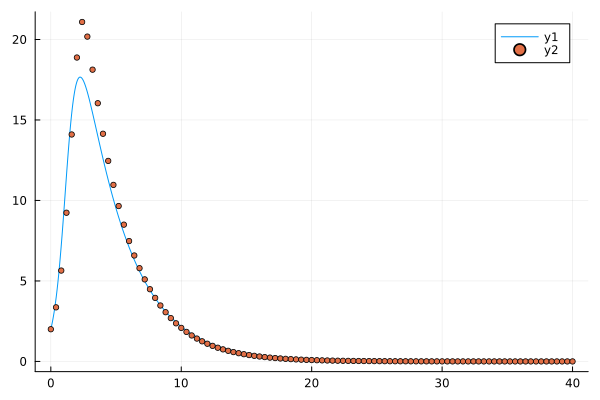
t,u = euler(ivp,100)
([0.0, 0.4, 0.8, 1.2000000000000002, 1.6, 2.0, 2.4000000000000004, 2.8000000000000003, 3.2, 3.6 … 36.4, 36.800000000000004, 37.2, 37.6, 38.0, 38.400000000000006, 38.800000000000004, 39.2, 39.6, 40.0], [[40.0, 2.0], [40.0, 3.3600000000000003], [37.824, 5.6448], [32.309563392, 9.237602304], [22.955812574113068, 14.098347972143465], [11.846716233916014, 18.879326888549297], [3.8481323991899314, 21.086968228643062], [0.9101651654719225, 20.179440954032497], [0.24831341010736108, 18.125240523849754], [0.08814887157621937, 16.04022646665765] … [0.10779875442250741, 0.00046555977168183534], [0.11642064730576815, 0.0004106963343499457], [0.12573238654890595, 0.0003623690448897747], [0.13578915501182542, 0.00031979598999951054], [0.14665055041968114, 0.0002822889677447333], [0.15838093853995575, 0.0002492422482653087], [0.17104983461430404, 0.00022012268289755302], [0.18473231530550818, 0.00019446099991993633], [0.19950946360071875, 0.00017184414454458064], [0.21546884930745222, 0.00015190853786125122]])
plot(t->sol(t,idxs=2),0,40)
scatter!(t,[u[2] for u in u],m=3)
There are two major ways to generalize from Euler.
Multistep methods#
The two major classes of IVP solvers are multistage and multistep methods. The multistage category is dominated by Runge–Kutta methods.
A multistep method has the general form
where \(\tau=t_{i+1}-t_i\) is the step size and the \(a_j\) and \(b_j\) are constants defining the particular method. Notable examples are backward Euler,
and the trapezoid formula,
Other common examples are in the following tables.
name/order |
steps \(k\) |
\(b_k\) |
\(b_{k-1}\) |
\(b_{k-2}\) |
\(b_{k-3}\) |
\(b_{k-4}\) |
|---|---|---|---|---|---|---|
AB1 |
1 |
0 |
1 |
(Euler) |
||
AB2 |
2 |
0 |
\(\frac{3}{2}\) |
\(-\frac{1}{2}\) |
||
AB3 |
3 |
0 |
\(\frac{23}{12}\) |
\(-\frac{16}{12}\) |
\(\frac{5}{12}\) |
|
AB4 |
4 |
0 |
\(\frac{55}{24}\) |
\(-\frac{59}{24}\) |
\(\frac{37}{24}\) |
\(-\frac{9}{24}\) |
AM1 |
1 |
1 |
(Backward Euler) |
|||
AM2 |
1 |
\(\frac{1}{2}\) |
\(\frac{1}{2}\) |
(Trapezoid) |
||
AM3 |
2 |
\(\frac{5}{12}\) |
\(\frac{8}{12}\) |
\(-\frac{1}{12}\) |
||
AM4 |
3 |
\(\frac{9}{24}\) |
\(\frac{19}{24}\) |
\(-\frac{5}{24}\) |
\(\frac{1}{24}\) |
|
AM5 |
4 |
\(\frac{251}{720}\) |
\(\frac{646}{720}\) |
\(-\frac{264}{720}\) |
\(\frac{106}{720}\) |
\(-\frac{19}{720}\) |
name/order |
steps \(k\) |
\(a_{k-1}\) |
\(a_{k-2}\) |
\(a_{k-3}\) |
\(a_{k-4}\) |
\(b_k\) |
|---|---|---|---|---|---|---|
BD1 |
1 |
1 |
(Backward Euler) |
1 |
||
BD2 |
2 |
\(\frac{4}{3}\) |
\(-\frac{1}{3}\) |
\(\frac{2}{3}\) |
||
BD3 |
3 |
\(\frac{18}{11}\) |
\(-\frac{9}{11}\) |
\(\frac{2}{11}\) |
\(\frac{6}{11}\) |
|
BD4 |
4 |
\(\frac{48}{25}\) |
\(-\frac{36}{25}\) |
\(\frac{16}{25}\) |
\(-\frac{3}{25}\) |
\(\frac{12}{25}\) |
Most multistep methods have an inconvenience requiring a short history of values to get started, but this is taken care of for you in software, and these methods can be more efficient than RK methods, especially for high-accuracy solutions.
Runge–Kutta#
The other major generalization of Euler’s method are the multistage methods, which are dominated by Runge–Kutta methods of the form
This recipe is completely determined by the number of stages \(s\) and the constants \(a_{ij}\), \(b_j\), and \(c_i\). Often an RK method is presented as just a table of these numbers, as in
The best-known RK method is given by
This formula is often referred to as the fourth-order RK method, even though there are many others, and we refer to it as RK4. Written out, the recipe is as follows.
Definition 4.1.1 (Fourth-order Runge–Kutta method (RK4))
Implicit methods#
More important than the multistep/RK split is the division into explicit and implicit formulas. Like an explicit function, an explicit method allows you to compute the next solution value in a finite number of operations in a well-defined manner. An implicit method defines the next solution value implicitly as the solution of an equation that is nonlinear if the ODE is nonlinear. A multistep formula in the form given above is implicit if and only if \(b_k\neq 0\). An implicit RK formula can have \(a_{ij}\neq 0\) for \(i\le j\).
For an implicit method used on a nonlinear IVP, an iteration is needed to find the next value at each time step, which greatly increases the computational cost per step. Hence, the only reason to use an implicit method is if it can take a drastically smaller number of steps for some reason….