
Differentiation matrices
Contents
1.6. Differentiation matrices#
Now we return to the example of indefinite integration we used at the beginning of the chapter,
If we discretize the domain \([a,b]\) by the nodes
then we were able to summarize imposing the ODE at the nodes through a linear system starting with the differentiation matrix
We can likewise build a differentiation matrix for the second derivative,
using LinearAlgebra
function diffmats(x)
    # assumes evenly spaced nodes
    h = x[2]-x[1]
    m = length(x)
    Dx = 1/2h*diagm(-1=>[-ones(m-2);-2],0=>[-2;zeros(m-2);2],1=>[2;ones(m-2)])
    Dxx = 1/h^2*diagm(-1=>[ones(m-2);-2],0=>[1;-2*ones(m-2);1],1=>[-2;ones(m-2)])
    Dxx[m,m-2] = Dxx[1,3] = 1/h^2
    return Dx,Dxx
end
diffmats (generic function with 1 method)
It’s unfortunate that the first and last rows in each differentiation matrix are first-order accurate, while the others are all second-order. More about that in a moment.
Double integration#
The problem
is solved by integrating twice. The two integration constants have to be specified by initial or boundary conditions. We’ll suppose that \(u(0)=1\) and \(u(1)=-1\).
The discrete collocation system is \(\bfD_{xx} \bfu = \bff\), where \(\bff\) represents the evaluation of \(f(x)\) on the nodes. We could proceed as we did before and modify the first and last rows of the system to express the boundary conditions, but we will take a different path here. If we put in the boundary values in place of \(u_0\) and \(u_n\), we have
Let \(\bfd_0,\ldots,\bfd_n\) be the columns of \(\bfD_{xx}\). Then
Define the chopping matrix \(\bfC\) as an \((n+1)\)-identity matrix with its first and last columns removed. Then we have
This system has \(n+1\) rows but only \(n-1\) unknowns remaining, so we will chop off the first and last rows as well. Define
The reduced linear system is now
In practice we can simply use row and column indexing rather than constructing the matrix \(\bfC\).
a,b = 0,1
f(x) = -50sin(x)
n = 200
h = (b-a)/n
x = [a + i*h for i in 0:n]
_,Dxx = diffmats(x)
A = Dxx[2:n,2:n]
rhs = (f.(x) - Dxx[:,1] + Dxx[:,n+1])[2:n]
ũ = A\rhs
u = [1;ũ;-1]

using Plots
plot(x,u)
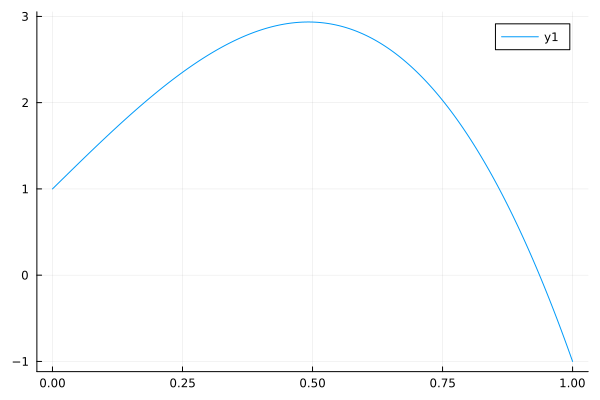
norm(Dxx*u-f.(x))/norm(u)
0.009251046829423357
Convergence#
Some experimentation will confirm that the code above converges like \(O(h^2)\). While this seems to be a natural result of using second-order FD formulas, it’s not quite so simple—the formulas get the problem correct to 2nd order, but that doesn’t prove that the solution is as accurate. We will investigate the link between them in the next chapter.
It is surprising, however, that our earlier code to solve \(u'=f\) also converged at second order, given that it used the first-order backward difference formula at the right endpoint. While the rigorous details are messy, in essence the saving grace of the method is that the less-accurate formula is used at only \(O(1)\) of the \(O(1/h)\) total equations, and this buys back one extra order of accuracy in the result. This is usually the case: the order of accuracy of the FD formula can be one lower at a fixed number of nodes as \(h\to 0\) without damaging the convergence.