
Group velocity and dispersion
Contents
5.3. Group velocity and dispersion#
Inserting the trial solution
into the advection equation \(\partial_t u + c\partial_x u= 0\) yields \(\omega - c \xi = 0\), or
This equation is known as the dispersion relation of the PDE. We think of it as a constraint on \(\omega\) as a function of \(\xi\). Note that the solution has constant phase in the exponential when \(\xi(x-\omega t/\xi)\) is constant, or \(x = \text{constant} + t (\omega/xi)\). Thus we identify \(\omega/\xi\) as the phase velocity of the solution.
Suppose now that \(u(x,0)\) consists of waves at just two nearby wavenumbers, \(\xi_0 \pm K\) for small \(K\). Then the dispersion frequencies are
and thus,
The term in front has the phase velocity \(\omega_0/\xi_0\), but the other term is an envelope that moves at velocity \(\omega'(\xi_0)\), which is known as the group velocity.
This argument can be generalized to any wave packet initial condition that is highly concentrated in wavenumber around \(\xi_0\). Group velocity is usually considered more physically relevant than phase velocity.
For linear advection, phase and group velocities are the same, but that is the exception. For the linear equation
the dispersion relation is \(\omega = -\xi^3\) and the group velocity is \(-3\xi^2\), which is three times the phase velocity. The fact that the group velocity varies with the wavenumber is known as dispersion. Since most initial conditions comprise modes at all wavenumbers, shapes lose coherence as the higher wavenumbers move more quickly.
We can also find the dispersion relation of the diffusion equation:
The negative imaginary part causes exponential decay in \(\exp[i(\xi x-\omega t)]\), and the decay rate grows with the wavenumber. It’s not terribly meaningful to discuss velocity for this relation.
Semidiscrete#
Centered#
For a centered 2nd-order difference in space on the advection equation, we easily obtain
This suggests a phase velocity \(c \sin(\xi h)/(\xi h)\), which closely approximates \(c\) when \(\xi h\approx 0\) but drops off to zero as \(\xi h\to \pm \pi\). The group velocity is
which also agrees well with \(c\) when \(\xi h\approx 0\). However, at \(\xi h=\pi/2\) the group velocity drops to zero, and as \(\xi h\to \pm \pi\), it approaches \(-c\). That is, high-wavenumber information can be expected to travel the wrong way!
include("diffmats.jl")
using OrdinaryDiffEq, Plots
n = 120;
h = 2π/n
println("sawtooth wavenumber is $(π/h)")
sawtooth wavenumber is 60.0
Here is a combination of a low-wavenumber and a high-wavenumber packet.
x,Dx,_ = diffmats(n,-π,π,periodic=true);
gauss = x -> exp(-18x^2)
u₀ = x -> gauss(x+2) + gauss(x-2).*sin(52x);
plot(x,u₀.(x))

When we solve the semidiscretization accurately for \(c=1\), we can see how the high-wavenumber packet travels in the wrong direction:
c = 1
adv = (u,c,t) -> -c*Dx*u
ivp = ODEProblem(adv,u₀.(x),(0.,3.),c)
sol = solve(ivp,RK4(),abstol=1e-8,reltol=1e-8);

anim = @animate for t in range(0,3,121)
    plot(x,sol(t),ylims=(-1.2,1.2),label="",dpi=128)
end
mp4(anim,"groupvel1.mp4")
┌ Info: Saved animation to
│   fn = /Users/driscoll/Dropbox/class/817/notes/advection/groupvel1.mp4
└ @ Plots /Users/driscoll/.julia/packages/Plots/4UTBj/src/animation.jl:154
The semidiscrete equation is dispersive, so shapes lose there coherence in the numerical solution.
tent = @. max(0,1-abs(x))
ivp = ODEProblem(adv,tent,(0.,6.),c)
sol = solve(ivp,RK4(),abstol=1e-8,reltol=1e-8);

anim = @animate for t in range(0,6,121)
    plot(x,sol(t),ylims=(-1.2,1.2),label="",dpi=128)
end
mp4(anim,"groupvel2.mp4")
┌ Info: Saved animation to
│   fn = /Users/driscoll/Dropbox/class/817/notes/advection/groupvel2.mp4
└ @ Plots /Users/driscoll/.julia/packages/Plots/4UTBj/src/animation.jl:154
Downwind#
Suppose \(c>0\) and we consider a (necessarily unstable) downwind first-order discretization, the forward difference. The semidiscrete dispersion relation is now
with group velocity
What does a complex phase velocity mean? The real part can be interpreted as usual, but for all nonzero \(\xi\) we also have a positive imaginary part, causing exponential growth in time for \(e^{-i\omega t}\).
Fully discrete#
Backward Euler#
We now combine the centered difference in space with backward Euler in time. We insert the Fourier mode to get
or
This is not very neat analytically, although it can be shown that \(\omega\) will not have a positive imaginary part for any value of the time \(\tau\).
ξh = range(-π,π,200)
ωτ = @. -1im*log(1 + 0.9im*sin(ξh))
plot(ξh,real(ωτ),label="Re",aspect_ratio=1)
plot!(ξh,imag(ωτ),label="Im")
plot!(ξh,ξh,l=(Gray(0.4),:dash),
    xaxis=("ξh",[-π,π]),yaxis=("ωτ",[-π,π]))
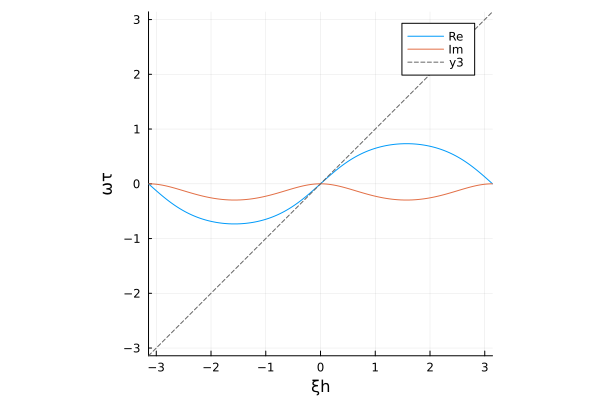
The picture above suggests that most parts of the solution have decay simultaneous with the wave propagation.
Midpoint#
Let’s combine the centered difference in space with a time integration scheme known as midpoint or leapfrog,
We insert the Fourier mode to get
or
If \(|c|\tau / h \le 1\), there are two real solutions for \(\omega \tau\) for each value of \(\xi\).
ωτ = @. asin(0.9*sin(ξh))
ωτ2 = @. mod(2π-ωτ,2π) - π
scatter(ξh,[ωτ ωτ2],m=2,msw=0,aspect_ratio=1)
plot!(ξh,ξh,l=(Gray(0.4),:dash),
    xaxis=("ξh",[-π,π]),yaxis=("ωτ",[-π,π]))
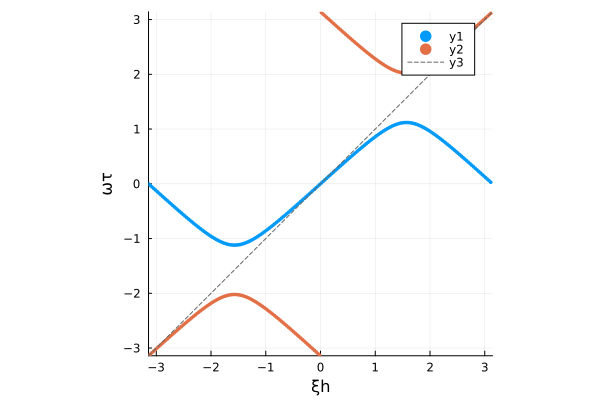
τ = 0.9h
init = x -> gauss(x)*sin(45x)
u₋ = @. init(x + c*τ)
u = init.(x)
anim = @animate for j in 1:100
    global u,u₋
    plot(x,u,ylims=(-1.2,1.2),label="",dpi=128)
    u₊ = u₋ + 2τ*(-c*Dx*u)
    u₋,u = u,u₊
end
mp4(anim,"groupvel3.mp4")
┌ Info: Saved animation to
│   fn = /Users/driscoll/Dropbox/class/817/notes/advection/groupvel3.mp4
└ @ Plots /Users/driscoll/.julia/packages/Plots/4UTBj/src/animation.jl:154
But if \(|c|\tau / h > 1\), there will be nonreal solutions that mean exponential instability in time.
asin(complex(1.1))
1.5707963267948966 + 0.4435682543851153im